
Ancient and current history of the Indigenous Forest Peoples across the Congo Basin
The Indigenous forest peoples of the Congo Basin, formerly known as Pygmies, are believed to represent one of the oldest living human cultures on earth.
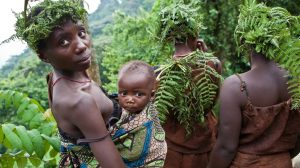
The Indigenous forest peoples of the Congo Basin, formerly known as Pygmies, are believed to represent one of the oldest living human cultures on earth. They have a documented 70,000 to 90,000-year time span in the Congo Basin, which extends from Uganda and Burundi westward across Central Africa to the Atlantic Ocean.
As the Bantu agriculturalists moved into parts of the Congo Basin from West Africa beginning some 3500 to 4500 years ago, the Forest Peoples formed mutual relationships with the agriculturalists. The two peoples traded agricultural products for forest products, and respected one another’s domains of knowledge.
Beginning in the 1870’s, colonists began to invade the Congo, and the relationships between the Pygmies and others worsened. Land was grabbed for forestry, rubber, mining and extractive cash crops, harming both the agriculturalists as well as the forest peoples. Damaging prejudices developed, and many Pygmy groups were forced to work for the Bantu farmers in semi-slavery. But as long as they could still retreat into the forest, they were able to maintain their culture and their dignity for at least part of each year.
At a certain point, the Pygmy peoples were subject to large-scale land grabs for agriculture, minerals, timber and coercive conservation. They no longer had access to their traditional lands and thus couldn’t engage in their traditional cultural or hunting and gathering way of life. Without land, they could not participate in local governance (based on land holdings), the trading economy, or mutual relationships based on respect. Across the region, they began to face severe poverty and malnutrition, illiteracy, lack of education and health care, social breakdown, substance abuse and discrimination by governments and neighboring peoples. Attempts to clear out the Pygmy peoples led to deadly attacks and mass killings in conservation, mining and agricultural areas. Sexual violence against girls and women was (and is) rampant, often based on a local myth that having sex with a Pygmy girl or woman can cure men of various ailments, and even offer magical protection during battle.
At the present (2025-2026), the Indigenous Batwa and Bambuti peoples in eastern provinces of DRC are experiencing repeated violent conflicts in which they do not play a role other than victim. These conflicts consist of the war between the Rwandan-backed M23 and the Congolese armed forces along with the Wazalendo (Patriot) militias, and other more localized conflicts – the worst of which is the ADF militia in Ituri and North Kivu provinces. The Pygmy peoples are often forced to flee as internally displaced people (IDPs). With no resources to protect themselves, they are frequently left out of organized humanitarian efforts. Their current situation is absolutely dire.
However, there are hopeful possibilities for the future. In the region, a number of Batwa men and women are gaining higher education and leading efforts to protect their people. Globally, scientists are beginning to recognize that Indigenous peoples are essential to preventing deforestation, and thus to reducing climate change and protecting biodiversity. On the African continent, the African Commission for Human and Peoples’ Rights has ruled that the Batwa people remain the owners of the massive Kahuzi Biega National Park lands, and must be allowed to return.
IfE has facilitated a network of Batwa rights defenders across the region, working to protect their rights and well-being, and to advocate for their ability to create and participate in hopeful options for the future. Read more about our Batwa rights coalition here.
#####